What Moisture Mapping Actually Is
Moisture mapping is the documented process of locating and measuring water inside building materials. Thermal imaging is one tool inside that process, not the whole answer.
- Thermal cameras show temperature patterns, not water directly
- Moisture meters confirm whether a cool spot is actually wet
- Hygrometers measure humidity in the air and inside cavities
- Floor plans get marked with affected zones and readings
- Daily readings track drying progress until materials hit goal
- Photos and notes get bundled into a report your adjuster can read
The 7 step Mapping Process We Follow
- walk through interview. You tell us what happened, when, and what you have already seen.
- Visual inspection. We look for stains, warping, separation, and active leaks.
- Thermal scan. Camera sweeps walls, ceilings, and floors for cold anomalies.
- Meter verification. Every suspect zone gets pin or pinless meter readings.
- Cavity checks. Borescopes and probes confirm wet insulation or subfloor.
- Mapping the floor plan. Affected areas get diagrammed with moisture percentages.
- Scope and estimate. The map drives the drying plan and any demo decisions.
Why Mapping Protects You During Insurance Claims
Adjusters want documentation, and a moisture map gives them exactly what they need to approve scope.
- Dated thermal images show the extent of loss at first inspection
- Moisture readings prove which materials were affected
- Daily logs show the drying trajectory and equipment performance
- Final dry readings confirm completion under IICRC S500 standards
- Clear maps reduce disputes over what was reasonable to demo or replace
- Photos tied to floor plan coordinates remove ambiguity about location
Our team at Avian Glen Water Restoration holds IICRC S500 (water damage) and S520 (mold remediation) certifications, and our reports are built to meet adjuster expectations. We also coordinate directly with your carrier when you want us to. For a deeper look at the full water damage restoration process from inspection through final clearance, the service page walks through each phase.
Conditions That Affect Thermal Accuracy
A thermal camera is only as good as the conditions it works in. Our techs control for the variables that throw off readings before they ever press the trigger.
- Delta T: a temperature difference of at least 10 degrees between wet and dry materials produces the clearest images
- HVAC settings: we ask you to leave the system running at a steady setpoint before we arrive
- Recent sun exposure: south facing walls can mask cool wet zones for hours after sunset
- Surface finish: glossy paint, foil backed insulation, and tile glaze all distort readings
- Airflow from open windows: evaporation skews surface temperatures and creates false positives
What Thermal Imaging Can and Cannot Do
Infrared is powerful, but it has limits you should know about before anyone quotes you a job.
What it does well:
- Reveals temperature contrasts behind paint and drywall
- Spots evaporative cooling on wet surfaces
- Tracks the spread of water through a ceiling or floor
- Documents the loss with clear, dated images
- Reduces unnecessary demolition by pinpointing affected zones
- Helps technicians find the migration path from source to puddle
What it cannot do:
- See through water, metal, or thick insulation
- Confirm moisture without a meter to back it up
- Read accurately on shiny or reflective surfaces
- Tell you the category of water (clean, grey, or black)
- Replace the judgment of a trained technician
- Work reliably when interior and exterior temperatures match too closely
For more on how categories change the scope, see our breakdown of category 1 vs category 2 vs category 3 water damage.
Where Hidden Moisture Hides in Avian Glen Homes
After thousands of Avian Glen inspections, certain hiding spots come up over and over. We always scan these areas, even when the visible damage looks isolated.
- Behind baseboards where wicking pulls water up the wall
- Inside wall cavities below sinks, dishwashers, and washing machines
- Under engineered wood and laminate flooring
- Above ceilings under second floor bathrooms
- Around window frames after wind driven rain
- Inside finished basement walls along the cold joint
- Behind tile shower walls and under shower pans
- In crawl space subfloor sheathing and rim joists
- Under kitchen islands where supply lines feed dishwashers and pot fillers
- Inside wall cavities behind cabinets where condensate lines run vertically between floors
If you are seeing warning signs but cannot locate the source, our guide on signs of hidden water damage walks through the early clues to watch for.
What to Expect During Your Appointment
A thermal moisture assessment in a typical Avian Glen home runs about within 2 hours. Larger losses or multi story properties take longer, but the rhythm stays the same.
- Arrival, ID check, and a quick review of your concerns
- Floor covers and shoe protection before any equipment enters the space
- Room by room thermal sweep with the homeowner welcome to watch
- Meter confirmation at every flagged location
- A walk through of findings on the camera screen before we leave
- A written report with annotated images delivered the same day in most cases
Reading the Numbers on a Moisture Map
The percentages on your map are not random. They guide every decision we make.
- Drywall dry standard: usually under 1 percent on a pinless scale
- Framing lumber dry standard: 12 to 16 percent depending on region
- Hardwood flooring dry standard: within 2 to 4 percent of unaffected boards
- Concrete: measured with relative humidity probes, not pin meters
- Carpet pad: often saturated even when carpet feels damp on top
- Plaster on lath: reads differently than drywall and needs a calibrated scale
Readings above goal mean drying continues. Readings at goal mean equipment comes out and the next phase begins. We also record unaffected control readings in the same room so the math behind "dry" is never a guess.
How Mapping Shapes the Drying Plan
The map is not just a report. It directly controls equipment placement, demolition decisions, and timeline.
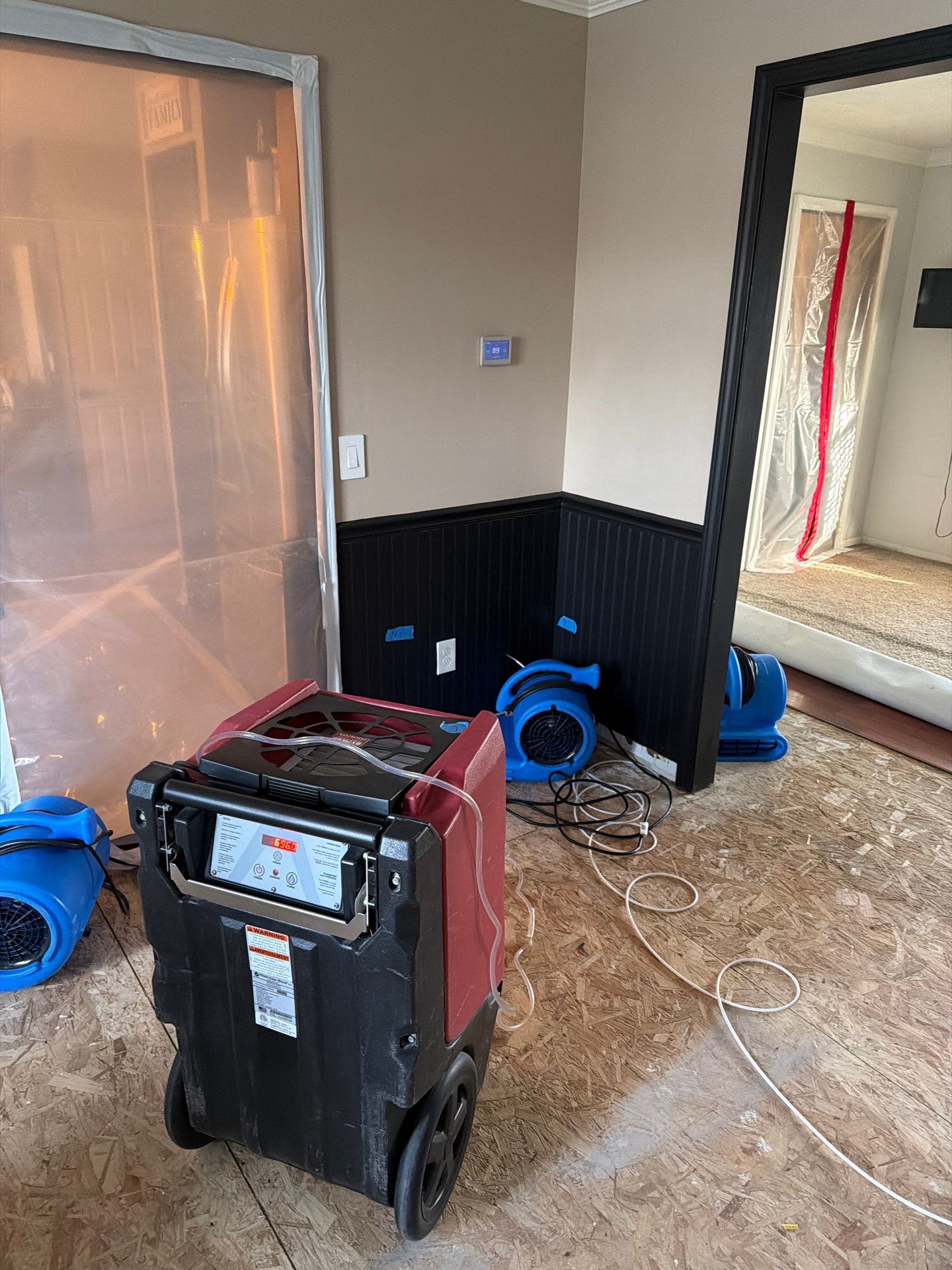
- Wider wet zones mean more air movers per linear foot
- Deep cavity moisture often requires drilled holes and injection drying
- Saturated insulation typically gets removed rather than dried in place
- Hardwood with high subfloor readings may need mat drying systems
- Persistent high readings after 48 hours trigger a rethink of the approach
- Containment plastic gets placed based on the mapped perimeter, not a guess
- Dehumidifier sizing comes from the cubic footage of the affected envelope
When to Call for a Thermal Inspection
Not every damp spot needs a full mapping appointment, but several situations make a free assessment worth your time.
- You smell musty odors but cannot find the source
- A leak was repaired but you are unsure if hidden materials dried
- Paint is bubbling, baseboards are cupping, or floors feel soft
- You are buying a home and want a non invasive moisture check
- A past flood was cleaned up by someone else and you want verification
- Your utility bill jumped and you suspect a slab leak feeding hidden moisture
Our crews dispatch in most cases within 2 hours for active emergencies, and we schedule standard thermal assessments at times that work for your household or business.